
Museum History
The Museum of Pioneer History began in 1954 as part of the
Chandler Historical Society. In 1959 the Society changed its name to The Lincoln
County Historical Society, Museum of Pioneer History.
Members joined from
all parts of the county and beyond. They gathered artifacts for housing in a
central place available to the public and began to document the history of the
area. The society sprang from roots first planted 1938 at the county fair, with
delegates representing all communities. During World War II the organization was
discontinued.
The Museum of Pioneer History's aim is to preserve records of
mans first uses of the land and his life to the present in the broadest
interpretation of a general historical museum.
After years of moving about
town into vacant buildings for museum housing, historical society members
purchased the vintage 'Mascho-Murphy' building at 719 Manvel in 1968 for
$10,000. Some renovations was accomplished with gifts and fund-raising.
The
building was without adequate heat or cooling and the roof often leaked, but the
museum and its collection continued to be a popular attraction. A newspaper
microfilm library was established and genealogical records assembled.
Expansion Project Launched
In 1982, the adjacent 'twin' building became for
sale. With private contributions of more than the $27,500 purchase price, the
museum space was increased to 8,000 square feet for the crowded, growing
collection. A four-year fund-raising drive was accomplished to complete
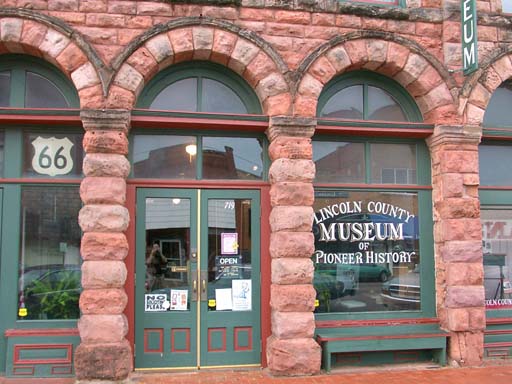
re-roofing and restoration of the two-story native stone buildings listed on the
National Register of Historic Places. They are the oldest existing commercial
buildings still in use in Lincoln County. The six remarkable Romanesque arches
framing the facade are fifteen feet high.
In 1987, contracts were let to
Robison-Beck Architects and Diepenbrock Construction Company for the $180,000
restoration project.
Generous contributions, ranging from $25 to $35,000
have come from individuals and organizations (including $100 from a third grade
class). With the addition of a $50,000 grant from the Oklahoma Historical
Society, the collection can now be housed in a modern-day, climate-controlled
museum with proper lighting and ultraviolet light protection.
The building's
restoration has been carried out mindful of U.S. Department of Interior
guidelines for historic buildings.
Museum Tour
Visitors to the museum
are first greeted by the old-fashioned traditional 'general store', replica of
the traditional small town information and supply center. The town post office
and telephone switchboard is included.
Items displayed are typical of those
found in general stores throughout Lincoln County at the turn of the century,
shortly after settlement and nearing statehood era, 1907. Although there were
specialty shops from meat markets to harness shops, the general store could have
everything one needed from salve to surreys.
This room is restored
authentically including the wood floor and fifteen foot high wooden beaded
ceiling. This building was build in 1897 by grocer A. E. Mascho who was nearly
killed here in the devastating cyclone of March 30, 1897 which demolished his
first structure. Mascho set about rebuilding immediately.
This space was
used most often as a general store. In 1912 for a time it became Jed Page's
variety 'racket' store.
A primitive cellar has been discovered in the
northwest corner. Presently it is not open for viewing. Accessible through a
trap-door, it is a simple 14 x 17 foot excavation. It is presumed builder-Mascho
intended to have adequate protection should another cyclone strike. After the
1897 storm, Chandler buildings were constructed of extra-thick walls in hopes of
avoiding repeated destruction.
During restoration work, a large, connecting
arched doorway was discovered which is now returned to an ample-sized attractive
opening, between the two buildings. It had been sealed and forgotten.
The
arch is similar to those constructed across the building facade. Called 'working
arches', the hand- cut sandstones are placed so they support each other and the
weight above. Air circulated through the interior storerooms through transom
windows in the arches which swung open inward with the pull of a chain.
At
the far rear of this room, an office, workroom and fireproof cement storage
vault have been constructed.
North Gallery, Front
This area was also
used for commercial ventures, built in 1898 by Macho as almost a twin to his
first. It was long known as 'Murphy's Meat Market' in the early part of this
century. J. F. Murphy was well- known for his genial nature and horseshoe
pitching skill. Note the 'No Loafing' sign he left beside the stairway wall. The
stairwell area originally featured an early elevator.
This gallery features
rotating exhibits and provides space for traveling or visiting exhibits. Two
west corners of the room feature permanent exhibits.
Historical
Paintings
On the north wall hang five acrylic mural-like paintings by Fred
Olds, Guthrie artist and sculptor. They are gifts of Col. and Mrs. John Embry.
They depict area history in the following sequence:
1. Arrival Indians;
2. Cattle trails, first settlements;
3. Religion;
4. The Run;
5. Early
settlement scenes.
Tilghman, Kent Exhibit
Famed Deputy U.S.
Marshal, Bill Tilghman was a county homesteader, sheriff, state senator,
Chandler town marshal and known for his long career of Oklahoma law enforcement
He traveled the country with a movie he made in partnership with Benny Kent,
'The Passing of the Oklahoma Outlaw'.
Benny Kent is known for his
contributions to early photography, both in stills, stereoptican views and
movies. He has provided documentation for many county scenes as well across
Oklahoma and the 101 Ranch. He was an English Jeweler who settled in Chandler
before 1900.
Printing, Publishing Exhibit
Lincoln County was without
connection to the outside world by railroads, or telephone during its first
years of settlement Communication was by word of mouth, mall delivered by
stagecoach, and newspapers.
The first to be published was the 'The Chandler
News' at the county seat. The printing and publishing exhibit feature a Linotype
type-setting machine although first type was set by hand. Also featured is a
hand operated press which printed 'Boomer' leaflets promoting opening of
Oklahoma. County newspapers have numbered some 49 different newspapers or titles
and mergers.
North Gallery, Rear
Library, Marionette Theater
In
the west section of the North building is the Hoffman Library and Armstrong
Marionette Theater.
The stage in the northwest corner has been constructed
to present marionette plays, reviving the legacy left by Chandler teacher, Fay
Armstrong. She was well-known for using her handmade marionettes in teaching.
Through gifts made by her sister, Ola Armstrong, this revival of entertainment
and education for young and old is made possible.
Generosity of Jeanne
Hoffman Smith, and Mrs. Roy Hoffman, Jr., has made possible the expansion of the
museum and its library in memory of their family.
Kitchen and restrooms are
located in the rear of this building. At the outside rear is Oklahoma's only
remaining brick outdoor restroom, more often called a 'privy' or 'out-house'. It
was build about 1910 and featured a primitive, but then, very advanced
mechanical commode. It has been restored, but not to its original public use.
Genealogy
The genealogy department In the museum is now equipped with
micro-film and micro-fiche readers. Research records include Lincoln County
cemeteries, marriages, census and early day county newspapers. Tract records and
voting registration books are also available.
All of the above are available
to the public.
Second Floor, North Gallery
In what was once upstairs
offices and/or apartments, you will find replicas of early physician and dental
offices, a one-room school, farm Implements, cobbler, milliner and seamstress
shops and the Embry Military Exhibit. The military exhibit is an outstanding
collection of county servicemen and women, courtesy of Col. John Embry.
Governors, Congressman
Lincoln County notables whose biographies are included
in the museum include former Governors Roy Turner and J. B. A. Robertson and U.
S. Congressman J. S. Pringey.
Second Floor, South Gallery
This area
features a replica of living quarters used by residents who owned or operated
the store below. Several apartment room walls have been altered to give visitors
a better view of the interiors. This area was occupied In 1912 by a young couple
just married, Jed and Laura Page from Carney. They operated the variety 'racket'
store below.
Their front parlor entrance hall was the narrow, steep, typical
stairwell which also served the adjoining building. Please use the handrail when
descending.
Route 66 Exhibit
The Museum of Pioneer History is located
on America's Main Street, Route 66. The Lincoln County Historical Society
compiled a Route 66 Exhibit entitled "26 Skidoo! The Early Years of Route 66, an
anniversary exhibit". It contains photos and artifacts that tell the history of
the highway, including construction, controversies, customs and changing
landscapes.
Antique car shows and car cruises are scheduled at intervals
during the year.
The History Book
A 1,572 page, hard bound volume,
the LINCOLN COUNTY, OKLAHOMA, HISTORY came off the press in 1988. This book,
available at the museum for research or purchase, contains the history of all
communities in the county, including schools, churches, businesses, cemeteries
and military and family histories. Never-before-seen photographs were used in
this first published history of Lincoln County.
Museum Annex
The
Oleson-Crane Building built in 1901, listed on the Historic Register, was
purchased in 1989 by Museum Patrons. (Please take note of the bronze plaque
denoting Historic Register listing on the front of the building). It is
undergoing current extensive renovations of the first floor. This is to be a
children's center and library, a multi-purpose space for Miss Fay's Marionette
Theater, other events, offices and storage.
* * * *
We hope you have
enjoyed your visit and invite your membership In the Lincoln County Historical
Society. Join us in this continuing celebration and presentation of Lincoln
County and Oklahoma heritage.
The society is a member of the Oklahoma
Museums Association, and provides members with quarterly newsletters. Membership
dues allow for operations of the museum and funds for a part-time curator.
*
* * *
2001 Officers and Staff
Jerry Lathrop, President
Bonnie
Walkingstick, Vice-President
Frankie Burchette, Secretary
Helen Brown,
Treasurer
Bill Ford, Accountant
Jeanette Haley, Curator
Board of
Directors
Virginia Frazier, Chairman
Ethel Wilson
Helen Brown
Frankie Burchette
Vivian Sage
Deborah Briscoe
Norma Cooper
Jerry
Lathrop
Bonnie Walkingstick
Steve Mathis
Larry Freeman
Don Ferrell
Museum hours: Mondays through Fridays, 9:30 a.m. until 4:00 p.m. Closed
Saturdays, Sundays and bank holidays. For tours or special weekend needs, call
the museum office.
Quarterly meetings and programs are held at the Museum on
Sunday afternoons.
Lincoln County Historical Society Museum
of Pioneer
History and Children's Resource Center
717-721 Manvel Avenue
Chandler,
Oklahoma 74834
E-mail: lincolncountyhs@sbcglobal.net
(405) 258-2425
FAX: 405-258-1809
The above was copied from a pamphlet published by
the museum.
If you have questions, contributions, or problems with this site, email:
Coordinator - Rebecca Maloney
State Coordinator: Linda Simpson
Asst. State Coordinator: Mel Owings
If you have questions or problems with this site, email the County Coordinator. Please to not ask for specfic research on your family. I am unable to do your personal research. I do not live in Oklahoma and do not have access to additional records.