

Bill Tilghman Celebration Day
Second
Saturday in October
The Bill Tilghman Committee of
Cromwell, OK and its citizens would like to express our sympathy to
those that have lost loved ones in the World Trade Center and The
Pentagon. Our prayers are with you.
Cromwell The Wicked Oklahoma
Oilfield Boom Of The 1920'
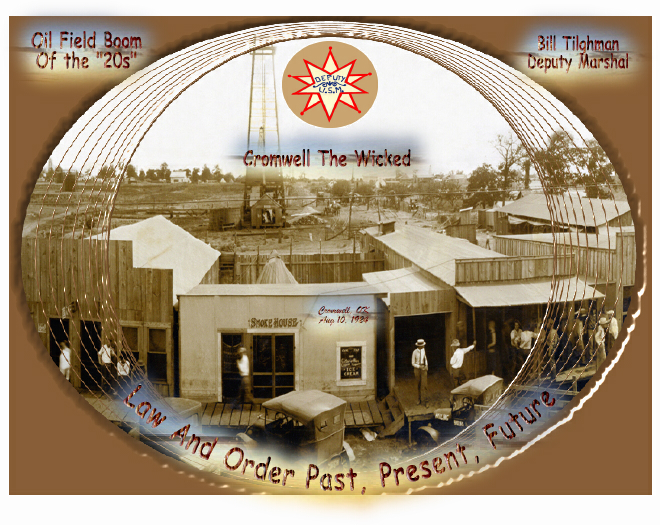
1924 Picture
Bill Tilghman Committee Meeting
We will
meet the first Thursday of each month at 8:PM.
in the Community
Building next to City Hall.
(Our First)
2001 Bill Tilghman
Scholarship Recipients Are
Sammie Whisnant and Ashley Green
Thanks everyone for making our day a huge success!!!
Robert Tilghman
and Lynn Lightman
Wayne Tilman
Our Honorary Grand Marshal's this
year are Robert Tilghman and
Lynn Lightman, great grandson and great
great granddaughter of
Bill Tilghman. We are very honored to have
them participate in our festivities.
Wayne Tilman, a distant cousin
of Bill Tilghman who lives in Florida will also
be attending. Wayne
is very knowledgeable on Bill Tilghman. We appreciate
the effort of
these relatives to come and participate in our Bill Tilghman Day.
Information on the Movie
The Passing Of The
Oklahoma Outlaws
Bill Tilghman Day Committee
P. O. Box 21
Cromwell, Oklahoma 74837
Oklahoma State
Historical Society - National Register of Historic Places
You Know My Name
Bill Tilghman Genealogy/History
as
told
By G. G. Grandson Paul Stewart
Bill Tilghman
Our Most Famous Person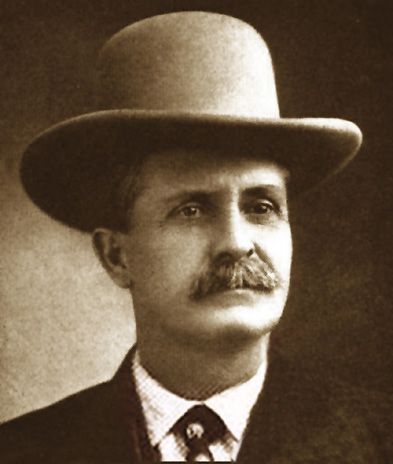
I want to express my
gratitude to Wayne Tilman for providing this history of Bill Tilgham for
my Cromwell page. If you are wondering why there is no (g) in his name,
his father didn't think it was necessary and omitted it. Wayne is a
distant cousin of Bill Tilghman and is in the process of getting this
book published. Wayne came to Cromwell gathering information for his
book.. We also met Bill Tilghman's great granddaughter.
Wayne
has written a very interesting story about Wiley Lynn & Crockett Long.
This can be found in the Cowboy Sports magazine.
The Long Trail that
ended in Cromwell: the Life and Death of legendary lawman Bill Tilghman,
By G. Wayne Tilman, Copyright, July, 1999
Bill Tilghman was born on
the 4th of July in 1854. His father served as a sharpshooter in Mr.
Lincoln's army during the War Between the States and came back partially
blinded. As time passed, the elder Tilghman's vision improved and the
family moved from one frontier outpost to another as he plied his trade
as a sutler for the army.
As a teenager, Bill Tilghman, armed with
his father's army-issue Sharps rifle, partnered with another young man
named Jim Elder and left Dodge City to become a buffalo hunter. Over the
next several years, his group grew to one of the largest on the
frontier. Tilghman killed over seven thousand buffalo, almost doubling
Buffalo Bill Cody's record.
In the mid-1870's, Tilghman's older
brother Richard joined the team and was subsequently killed by a passing
war party.
Tilghman met and fell in love with Flora Kendall. He went
off to scout for the army and she married another man. Her husband was
killed in a horse-related accident, and the pregnant Flora moved back to
Dodge with her family. Tilghman found out about this and returned and
married her. They partnered with Neal Brown and bought a ranch on Bluff
Creek, outside Dodge City. The baby, James, was born and he was sickly.
He died as an infant.
Many of Tilghman's buffalo hunting friends
became famous in their own right, once the buffalo hunting had ceased.
They all headquartered around Dodge City and the group influenced one
another as they all drifted towards law enforcement. One was a Canadian
who had to use a cane due to having been caught in flagrante delicto
with another man's wife. In the bedroom gunfight, the former buffalo
hunter killed the husband, but only after the man had shot through the
woman (killing her) and hitting the hunter in the rear end. His name was
Bat Masterson. His brothers, Jim and Ed were part of the group.
Another set of three brothers were buffalo hunters who settled, albeit
briefly, in Dodge. They were Wyatt, Morgan and Virgil Earp. They were in
Dodge until 1882, when they drifted down to Tombstone and the ultimate
confrontation with the Clanton clan at the O.K. Corral.
Not a peace
officer, the Earps friend, Doc Holliday was also in Dodge. He was a
tubercular dentist whose coughing scared away patients. So, he turned to
gambling and drinking. His consort, Big Nose Kate, a member of Hungarian
nobility, was the only woman allowed in the all-male Long Branch Saloon
(sorry, Miss Kitty.) The only reason she was allowed was because nobody
had the nerve to ask the possibly psychotic dentist's girlfriend to
leave.
Bat Masterson became Sheriff of Ford County, Kansas in 1878.
He named Bill Tilghman his undersheriff. Tilghman served in this role
until 1884, when he took the higher paying, less travelling position as
Marshal of Dodge City.
Tilghman had bad luck with his ranching
endeavors in Kansas. Indians burned his ranch in 1879; Neal Brown saved
Flora and baby Charles. They rebuilt, but were cleaned out once again by
the Great Blizzard of 1886.
By the late 1880's, the Texas herds
ceased being driven up the Chisholm Trail to Dodge and the town was calm
and civilized. Tilghman could claim part of the responsibility for this,
though he probably was more the steadying influence that allowed for the
real taming of Dodge: the arrival of wives and ministers.
1889 saw
the entire Tilghman clan at the land rush at Guthrie, Oklahoma
Territory. It was Tilghman who, with friend Jim Masterson, cleared
squatters off the main street with mules on either side dragging logs
chained together down the middle. Tilghman riding at the front with a
twelve gauge probably helped move people…
His fame as a lawman now
established, Tilghman was asked by Marshal Bill Grimes to be a Deputy
U.S. Marshal. Deputies had no salary--they were paid a couple of dollars
for each warrant served, six cents a mile for travel and rewards. The
average deputy marshal in the 1880's and '90's made about $500/year.
Tilghman and Flora now had four children. She had grown bitter over his
absences as a lawman and ultimately contracted consumption
(tuberculosis), which did not help her moods.
From 1893-5, the
scourge of the Oklahoma and Indian Territories was the Doolin-Dalton
gang. Bill Doolin later became the subject of the Eagle's song
"Desperado."
Tilghman, ex-French Foreign Legionnaire Chris Madsen,
and Heck Thomas were assigned to capture the gang dead or alive. After a
robbery in Southwest City, Missouri, where a prominent politician was
killed, the "alive" was deleted from the judge's orders.
On January
15, 1895, Bill Tilghman single-handedly captured Bill Doolin in Eureka
Springs, Arkansas. The award, $5000, was one of the largest ever
offered.
In August, Doolin escaped. The reward was "capture and
conviction." Tilghman did not get a penny for his three years of work.
Heck Thomas later killed Doolin near Lawson (Quay), O.T.
The Three
Guardsmen, Tilghman, Thomas and Madsen eventually killed or led posses
that killed or captured the rest of the gang.
In 1900, Tilghman was
elected Sheriff of Lincoln County, based out of Chandler. Flora died
that year.
Three years later, he married twenty-two year old Zoe
Stratton of Ingalls. He was 49.
In the ensuing years, he made two
movies--"The Bank Robbery" with inept bank robber and gubernatorial
hopeful Al Jennings and "The Passing of the Oklahoma Outlaws."
His
friend Teddy Roosevelt asked him to go to Mexico--remember, there was no
F.B.I. at the time--and capture and bring back a railroad embezzler. He
accomplished that task with aplomb. Tilghman, Madsen and lawman Crockett
Long all held special, statewide jurisdiction deputy commissions from
each of the early governors of the new state of Oklahoma. Tilghman was
called out several times to quell KKK and Indian (Chitto Harjo--"Crazy
Snake") uprisings.
He was elected to the Oklahoma Senate in 1910,
resigning after a year to accept a two-year appointment as Chief of
Police of Oklahoma City.
Tilghman spent the years between 1913 and
1924 running Champion Stock Farm in Chandler (his horse Chant, was a
Kentucky Derby winner and the source for his thorobred bloodlines) and
traveling with his "Oklahoma Outlaws" movie.
Governor Trapp asked
Tilghman to go to Cromwell in the spring of 1924 to tame "the wickedest
town in Oklahoma." No one knew, including his wife, but he was dying of
cancer and in dire pain. He accepted.
Cromwell in 1924 is depicted
best by the panoramic photo taken in August of that year and on display
in the Cromwell Post Office. Most of the buildings were related to
drinking, gambling and prurient concerns. Layabouts hung around outside
of pool halls and bars. Naked prostitutes lounged in windows and
doorways. Murders went unsolved; bodies often lay in the street for
hours. Drugs, even more than the then-prohibited alcohol, were the main
cause for the malaise. A man named Killian reputedly ran organized
crime, though he was a puppet for unknown Oklahoma City crime bosses.
Even the local federal prohibition agent, Wiley Lynn, was generally
accepted to be on the take. The Amerada oil derricks and tanks gave the
rough and tumble town a perpetual smell of oil. The wooden buildings
were soaked with oil.
Tilghman spent about six months a town marshal
and made inroads into cleaning up the town. He had little or no help
from the county sheriff. And Lynn, from the federal government, was a
hindrance. He released more than one Tilghman arrestee before the
seventy-year old marshal found out.
On Halloween night,1924,
Tilghman, Deputy Hugh Sawyer, and businessman W.E. Sirmans were having
coffee at Ma Murphy's cafÈ (adjacent to her reputed brothel) when a shot
rang out.
Tilghman, whose cancer had made wearing a gunbelt
intolerable, drew his Colt's .32 automatic from a vest pocket and went
into the street to investigate. A drunken Wiley Lynn stood there, gun in
hand. Brothel madam Rose Lutke was standing next to him. Another known
prostitute, Eva Caton was sitting in Lynn's car with her date, a
furloughed army sergeant.
Tilghman clasped Lynn's gun hand while
jamming his own automatic into Lynn's ribs. He yelled for Hugh Sawyer to
disarm Lynn. Rose Lutke, Lynn and Tilghman stood body to body in the
dark as the young deputy rushed towards them. Two shots rang out. Lutke
started screaming. After a few seconds, Tilghman slumped against the
wall. Lynn disarmed Sawyer, who had yelled "Wiley Lynn has shot the
Marshal!" though he had been unable to actually see the incident.
Lynn and Lutke jumped in the car and sped off.
William Matthew
Tilghman died twenty minutes later on a sofa in the used furniture store
next to Ma Murphy's. He had been hit twice in the left lung and bled to
death internally.
Perhaps the most interesting aspects of his death
were those things that happened afterwards.
Tilghman's body lay in
state at the Oklahoma State Capitol.
One month later, the town of
Cromwell was torched. No family homes were set afire, but every
flophouse, bar, pool hall and brothel was leveled. It is said that the
fire was retribution and was set by one of the "good guys."
Had it
been a Cromwell resident, the fact would have come out in the ensuing
three-quarters of a century. It is more likely that it was a Tilghman
lawman friend, like Madsen or Long.
As reputedly promised by
organized crime bosses, Lynn got the best jury, witnesses and counsel
that money could buy. He was found not guilty. Key witnesses never
showed up.
Rose Lutke disappeared.
In 1932, Wiley Lynn was killed
in a shoot-out in a drug store in Madill by none other than Oklahoma
Crime Bureau agent Crockett Long. Long and a teen-aged bystander also
died.
At the onset of WW II, skeletons were found in the Amerada Oil
tanks in Cromwell. Had the mystery of the whereabouts of Rose Lutke been
solved?
I leave the reader with this final question about the death
of my relative: three people were standing touching. If Lynn had fired
not-immediately lethal shots, would not have the tough old lawman
squeezed the trigger of the automatic he held against Lynn's ribs? Or,
perhaps did the third person there--one whose brothel had been closed by
Tilghman--fired the shots to get the price on the lawman's head? Was
that why Tilghman did not shoot Lynn? I doubt that we will ever know for
sure…
Marshal E.D. Nix observed that "Tilghman was the handsomest man
I ever met."
Teddy Roosevelt said "Tilghman would charge Hell with a
bucket."
Perhaps it was famed lawman Bat Masterson who summed it up
best: "Tilghman was the greatest of us all."
If you have questions, contributions, or problems with this site, email:
Coordinator - Rebecca Maloney
State Coordinator: Linda Simpson
Asst. State Coordinator: Mel Owings
If you have questions or problems with this site, email the County Coordinator. Please to not ask for specfic research on your family. I am unable to do your personal research. I do not live in Oklahoma and do not have access to additional records.