
The last Comanche raid into the Chickasaw Nation occurred in the
summer of 1866. It was never reported to the commander of Ft. Arbuckle
and no mention will be found in the War Department records.
It
would not be for another twenty years that the participants of the
reprisal raid by the Chickasaws would begin to talk of the event.
Even though the Chickasaws were "civilized", they were considered in
the same vain as the Comanche by the government. The Army would meet
Indians fighting Indians with serious consequences.
In June of
that year, the Comanches raided across the Chickasaw Nation to the
western border of the Choctaw Nation. There were three hundred fifty
Comanches taking part in the raid that began near the present day town
of
Purcell and the Comanches continued south crossing Mill Creek near
Harris' Mill.
The raiders continued on east to the Sealy
settlement on Goose Creek. Here they began gathering horses, mules and
cattle. They did not harm any of the Chickasaw farmers or ranchers
unless they resisted and did not burn any of the buildings.
From
here they rode on east to the James settlement on Delaware creek near
the Chickasaw Rock Academy near present day Wapanucka. Here they turned
south through a gap in the hills to the place of Mrs. Luffie Mosley the
mother of Palmer Mosley, later the governor of the Chickasaw Nation.
Once again the Comanches stole every head of livestock in sight.
The rapidly moving raiders were now being trailed by a Chickasaw mounted
guard who were several days behind the raiders.
After the Mosley
raid the Comanches turned to the Keel community on Pennington Creek
northwest of Tishomingo. Upon reaching Blue River, the raiders crossed
at the site of the old town of Bolton. They made their first camp in
the Arbuckle Mountains at Rattlesnake Springs seven miles
southeast
of Mill Creek. Their next camp was in the Arbuckles near the present
day site of Springer. Their next camp was on Wild horse Creek west of
the town of Davis.
Their next camp was on Cache Creek in the
Wichita Mountains where they sent the livestock on north to a canyon
where they split their forces in two with half camping while the other
half took the stock up the Cache Creek Valley.
All this while,
the Chickasaws were in hot pursuit with two hundred fifty men of their
own armed with rifles and pistols. The Chickasaws became worried that
the army might have gotten word that they were in pursuit of the raiders
and feared retribution from the army.
A man was sent to Ft.
Arbuckle to ask the army if they had heard of any Comanche raiding in
the area. They scout was told that there were no reports and the scout
left without imparting any information to the army about the current
raid.
The pursuit continued and the Chickasaw scouts reported the
main camp of Comanche had been discovered on Cache Creek. That night
the two hundred fifty Chickasaws surrounded the Comanche camp. The
Chickasaws had the camp completely surrounded and settled down for the
night.
At dawn, a bugle call broke the morning stillness and two
hundred fifty rifles sent a volley of leaden messengers into the
Comanche camp. The Chickasaw's plan was so complete that the Comanches
were cut off from their horses and escape was attempted on foot. Not a
single Comanche escaped being cut down by the Chickasaw rifles.
Soon, a truce was called for by the Comanches and it was agreed that the
Chickasaw could have their stock back and the Comanche could attend
their wounded and bury their dead.
The Chickasaws returned to
their farms and ranches with all their livestock without the loss of a
single man. Word was never leaked by the participants of the reprisal
raid for fear of severe consequences from the government. However,
nothing was ever done about it.
Years later, the leaders of the
Chickasaw reprisal raiders were identified as Scott Sealy, Gabriel
Brown, Wash Colbert, Jim Daley, Alfred Humes, Jackson Billis, Willis
Tuskatombee, Puckinchubbe, Jim Patterson, and Harris
Greenwood.
This was the last big raid by the Comanche into Indian Territory.
As the years passed there would be small raids by young Comanche braves
sowing wild oats but there would never be another raid of this magnitude
in Indian Territory.
Contributed by Dennis Muncrief - June, 2003
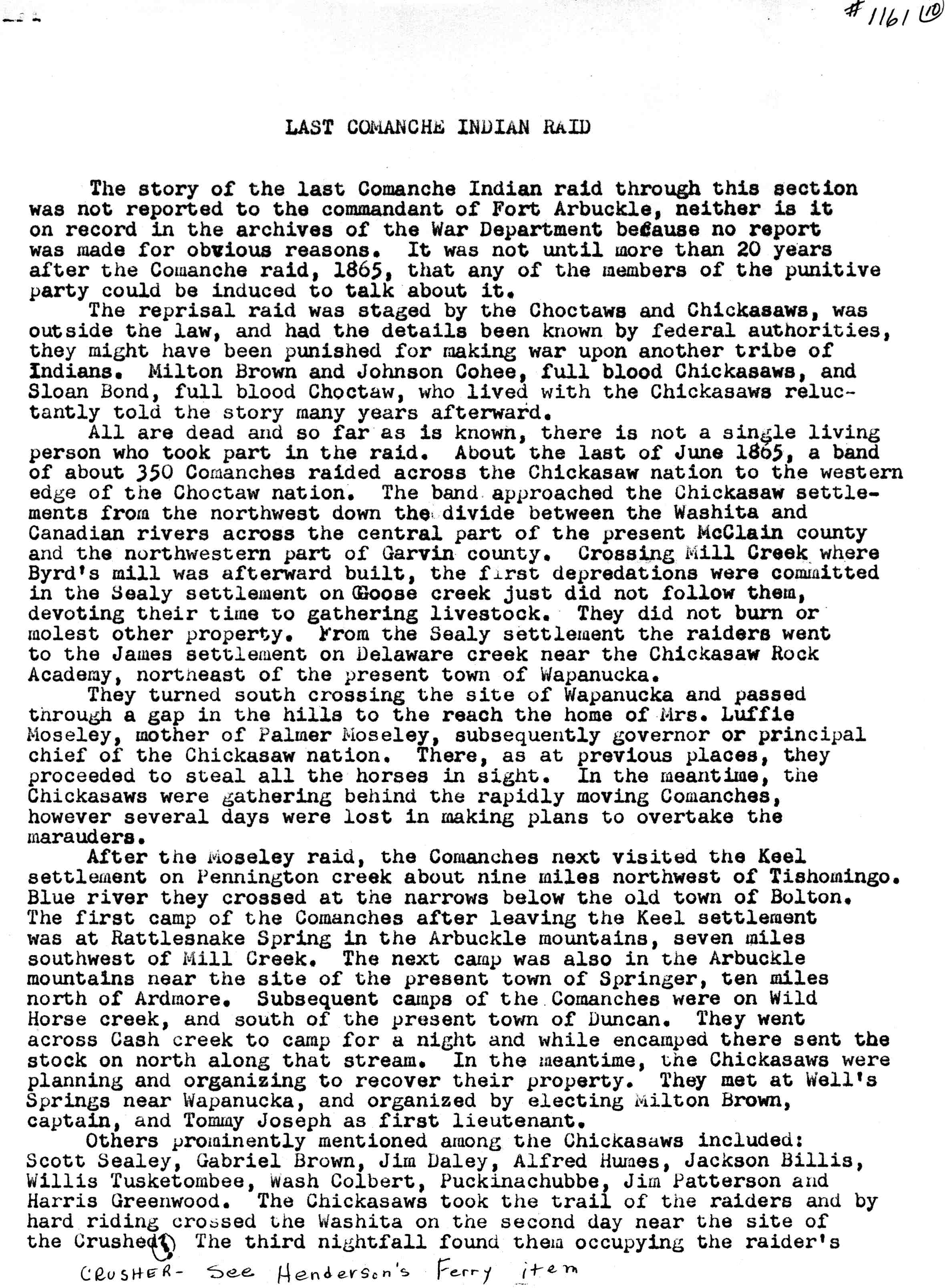
Page 1 transcript:
The last Comanche Indian raid through this section was not reported to the commandant of Fort Arbuckle, nor was it recorded in the archives of the War Department. It occurred in June, 1865, and the details were not given out until more than twenty years later by surviving members of the Chickasaw and Choctaw tribes.
About 350 Comanches raided across the Chickasaw nation to the western edge of the Choctaw nation. They came down Mill Creek, crossed Goose Creek, Delaware Creek, and Wapanucka, stealing horses and other property, but destroying no property. They then went to the Keel settlement near Tishomingo, and from there to the Arbuckle mountains, camping near the present towns of Springer, Ardmore, and Duncan.
The Chickasaws organized to recover their property. Milton Brown, Captain; Tommy Joseph, First Lieutenant. Among the Chickasaws who took part in the pursuit were Scott Sealey, Gabriel Brown, Jim Daley, Alfred Hures, Jackson Billis, Willis Tuskotembee, Wash Colbert, Puckinchaubbe, Jim Patterson, and Harris Greenwood.
Handwritten note:
“CRUSHER – See Henderson’s
Ferry site.”
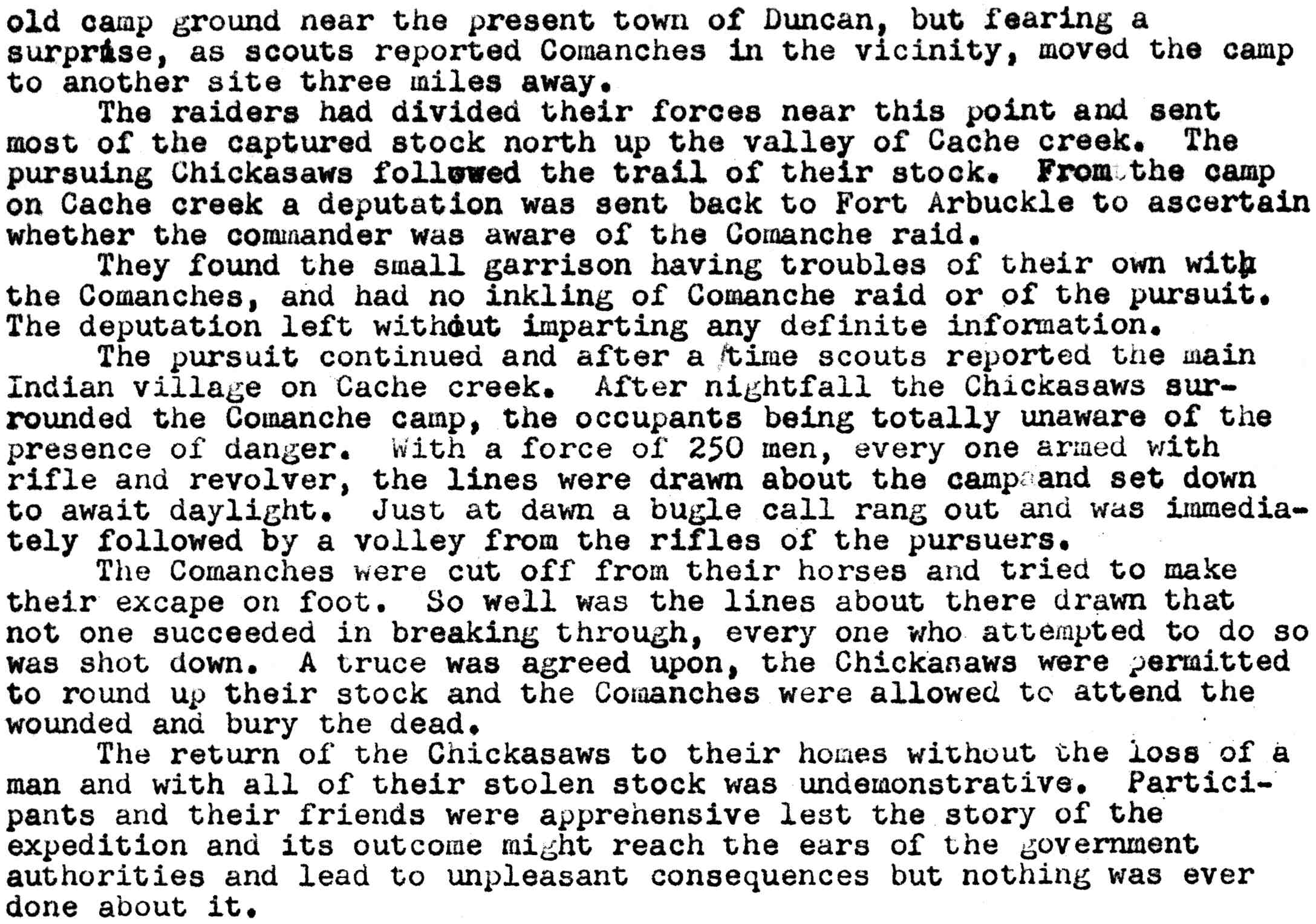
Page 2 transcript:
old camp ground near the present town of Duncan, but fearing a
surprise, as scouts reported Comanches in the vicinity, moved the camp
to another site three miles away.
The raiders had divided their
forces near this point and sent most of the captured stock north up the
valley of Cache creek. The pursuing Chickasaws followed the trail of
their stock. From the camp on Cache creek a deputation was sent back to
Fort Arbuckle to ascertain whether the commander was aware of the
Comanche raid.
They found the small garrison having troubles of
their own with the Comanches, and had no inkling of Comanche raid or of
the pursuit. The deputation left without imparting any definite
information.
The pursuit continued and after a time scouts
reported the main Indian village on Cache creek. After nightfall the
Chickasaws surrounded the Comanche camp, the occupants being totally
unaware of the presence of danger. With a force of 250 men, every one
armed with rifle and revolver, the lines were drawn about the camp and
set down to await daylight. Just at dawn a bugle call rang out and was
immediately followed by a volley from the rifles of the pursuers.
The Comanches were cut off from their horses and tried to make their
escape on foot. So well was the lines about there drawn that not one
succeeded in breaking through, every one who attempted to do so was shot
down. A truce was agreed upon, the Chickasaws were permitted to round up
their stock and the Comanches were allowed to attend the wounded and
bury the dead.
The return of the Chickasaws to their homes
without the loss of a man and with all of their stolen stock was
undemonstrative. Participants and their friends were apprehensive lest
the story of the expedition and its outcome might reach the ears of the
government authorities and lead to unpleasant consequences but nothing
was ever done about it.
[Ed. Note; I have read several versions of this raid and there are some small discrepancies in this version but is as close to the true story as I have come across. I am posting this version as the 'official' version. There were other raids by small groups of young men of the Comanche who were sowing their wild oats. The 1865 raid was the last large raid in I.T. The Comanche turned their attentions to Texas and Mexico. The Treaty of 1866 gave the western lands of the Chickasaw/Choctaw lands west of the 98th Meridian to the U.S. government to use as a reservation for the Comanche. - Dennis Muncrief, Nov. 2001]
If you have questions, contributions, or problems with this site, email:
Coordinator - Rebecca Maloney
State Coordinator: Linda Simpson
Asst. State Coordinator: Mel Owings
If you have questions or problems with this site, email the County Coordinator. Please to not ask for specfic research on your family. I am unable to do your personal research. I do not live in Oklahoma and do not have access to additional records.