

Chickasaw Rancher
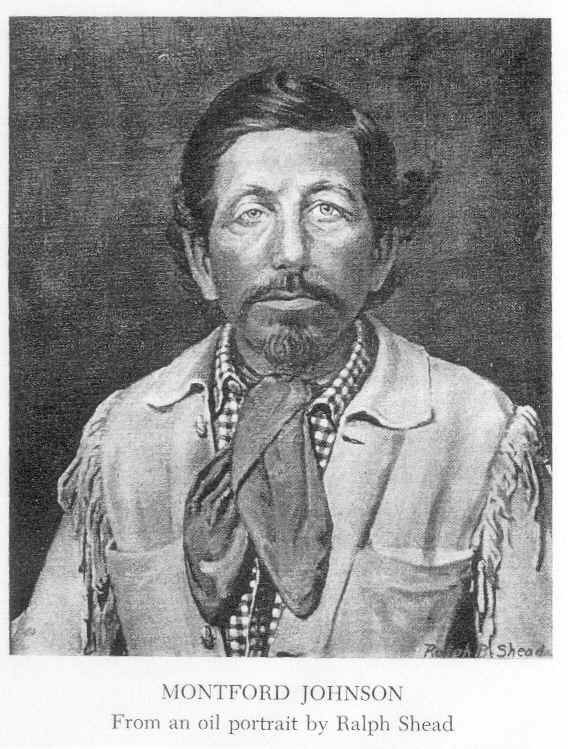
For those of you who are interested in Montford Johnson the famous "Chickasaw Rancher", here is what I could find at the library in Ardmore. They have three books in the library and one is in the reference section and the other two are in the archive section. I checked on Amazon.com and the original book lists for over $400 which is quite a bit for a book published in 1961. Here goes:
Charles N. Johnson was born in England and immigrated to America when he was 19 years old. He then emigrated to Indian Territory and the Chickasaw Nation. He married a Chickasaw woman named Rebekah Courtney and became a citizen by marriage. Montford Johnson was born in 1843 in the Arbuckle Mountain area. Shortly after Montford was born Rebekah died. Charles went back East and left Montford and his older sister Adelaide with Chickasaw relatives at Ft. Arbuckle.
Stationed at Ft. Arbuckle was a Sgt. James Campbell. Campbell's son Michael married Adelaide and Montford married Michael's sister Mary Elizabeth Campbell in 1861. When Ft. Arbuckle was abandoned by Federal troops in 1861 it was generally believed that all Federal dependents went with the troops to Ft. Leavenworth, KS. This was not the case as Mary, Michael and Sgt. Campbell's wife, who was a slave owner, stayed behind. Michael later was named major in the Chickasaw Battalion during the Civil War.
Montford went into the cattle business in 1861 at Ft. Arbuckle on a small scale. In 1865, Montford and Jesse Chisholm were buffalo hunting on the Canadian near Chisholm's Trading Post. Montford remarked to Jesse that this would be prime ranch land if it weren't for the wild Indians and the buffalo. Jesse said that he would talk to the chiefs of the wild tribes about permitting him to ranch there without interference.
The wild Indian chiefs agreed to allow Montford to ranch there if he only had Indian, Negro or Mexican cowboys. They would not allow white cowboys and by no means would they allow a Texan to work there. The Comanche and Kiowa hated the Texans even more than they did the Mexicans.
Montford moved his operation to Old Ft. Arbuckle near present day Byars in the late 1860's and the rest is history. A mile north of Byers is the old community of Johnsonville which was named after Montford.
© Submitted by Dennis Muncrief, February 2009.
Montford Johnson was inducted into the Chickasaw Nation Hall of Fame in 2024:
Montford
Johnson was a Chickasaw cattleman and entrepreneur who overcame
adversity to establish a ranching empire along the Chisholm Trail. He
was born in November 1843 and raised by his grandmother with his
sister, Adelaide. He cared for his grandmother’s livestock and
eventually accumulated his own.
Following the Civil War,
Johnson established ranches throughout what is now central Oklahoma
after negotiating with the Plains tribes west of Chickasaw territory.
He also had a role in establishing two stores and a bank. His family
also helped establish eight towns in Oklahoma. He was a pioneer in the
agriculture industry and had approximately 35,000 cattle across 1.3
million acres.
Johnson worked to improve the lives of First
Americans who had been forced onto reservations by the U.S.
government, making agreements for them to take cattle from his herds
whenever they needed food. He also advocated for the release of First
American prisoners at Fort Marion in St. Augustine, Florida, during
the Red River War in 1874.
He dedicated his life to helping
others with food, shelter and guidance. He supported ranchers in
building their own businesses and housed children who had been
orphaned, taking them in as his own.
For his contributions,
Johnson was inducted into the Hall of Great Westerners at the National
Cowboy and Western Heritage Museum in April 2020. A book based on his
life, “The Chickasaw Rancher,” written by Neil R. Johnson, was first
published in 1960 and later revised. A feature film, “Montford: The
Chickasaw Rancher,” and documentary, “Montford: An Original Brand,”
were produced by Chickasaw Nation Productions, along with elementary
and secondary curriculum for students.
Johnson helped shape
modern-day Oklahoma. He rebuilt ranching operations in the aftermath
of the Civil War and showed resilience during the Land Rush of 1889.
He enabled Chickasaw history and culture to be shared with the public
in new ways, and showed what can be accomplished when one works hard,
follows their passions and takes care of those around them.
Birth: 1843 Death: 1896
If you have questions, contributions, or problems with this site, email:
Coordinator - Rebecca Maloney
State Coordinator: Linda Simpson
Asst. State Coordinator: Mel Owings
If you have questions or problems with this site, email the County Coordinator. Please to not ask for specfic research on your family. I am unable to do your personal research. I do not live in Oklahoma and do not have access to additional records.