First Governor of the
Chickasaw Nation
Oklahoma has no more substantial citizenship that may be recognized among the
members of the Chickasaw Nation that helped to make the State and Nation what it
is today.
In Oklahoma,
there have been two Governors, Supreme Court Justices, Corporation
Commissioners, Congressmen, Senators, U.S. Attorneys, Secretary of State, and
numerous State Senators and Representatives of Chickasaw heritage.
In 1818, the Chickasaws sold their lands in Tennessee
and Kentucky to the United States Government. In consideration of that treaty,
the United States paid each Chickasaw enrolled at that time the sum of $1,000
per annum for twenty years. In those days, this was a considerable sum of money
and made the Chickasaws very wealthy. They amassed large farms, slaves,
livestock and homes. They became very business and politically oriented and
educated their children. The Chickasaws in Mississippi became very comfortable
through their Tribal leadership.
The Treaty of Dancing Rabbit Creek in 1830 provided
for the removal of the Choctaws of Mississippi to the Indian Territory. The area
of land the Choctaws received was roughly the southern half of Oklahoma south of
the Canadian River. The surge of white settlement in Mississippi was again
smothering the Chickasaw. The Chickasaws purchased a one-fourth interest in the
Choctaw lands in the West for the sum of $150,000. At this time there were only
about 5,000 Chickasaw and over 30,000 Choctaw in the Nations. The removal of the
Chickasaws were in 1837-38.
Although the Chickasaw were autonomous in the Choctaw
Nation, they were in danger of being absorbed into the Choctaw society and
culture. On January 17, 1854, the treaty of Doaksville, I.T. between the two
tribes, provided for a separation of the Chickasaw Nation, physically,
culturally, and politically. On June 22, 1855, in Washington, the treaty was
formally recognized and separated the two Nations. On August 30, 1856, in
Tishomingo, I.T., the Chickasaw constitution was formally adopted and the words
"Principle Chief" were changed to "Governor".
The Jacobite Uprising in Scotland in 1715 and the
subsequent great Highland Clearances of 1745 sent many Scottish refugees to
America. Among those fleeing Scotland and English rule were Logan Colbert, John
Mohn McIntosh as well as this writers ancestors who also eventually journeyed to
Indian Territory.
Logan Colbert, the patriarch of the noted Chickasaw family was the father of
Mollie Colbert. Mollie married a man named Christopher Oxbury, a mixed Cherokee,
and lived in Pontotoc, Mississippi where she gave birth to a daughter named
Elizabeth or 'Betty'. Here the story gets a little fuzzy. Elizabeth married a
white man named Harrison but the marriage didn't last long. According to the
Chickasaw custom, when a marriage dissolves, the woman simply moves back to her
mothers house. This Elizabeth did but she was with child by this time. Her first
son Cyrus was born (August 22, 1817) at his grandmothers house. Elizabeth
shortly thereafter married Malcolm McGee but shortly returned to her mother's
house. Cyrus' father at first refused to move to Indian Territory with the
Chickasaws but later did come to the Nations. Cyrus refused to have anything to
do with him.
Cyrus
Harris, mother Elizabeth and family left Lake Huron, Mississippi on November 1,
1837. He stayed for a few weeks at Skullyville, I.T. then moved on to Blue River
north of Tishomingo. In 1850 Harris was a Chickasaw delegate to Washington
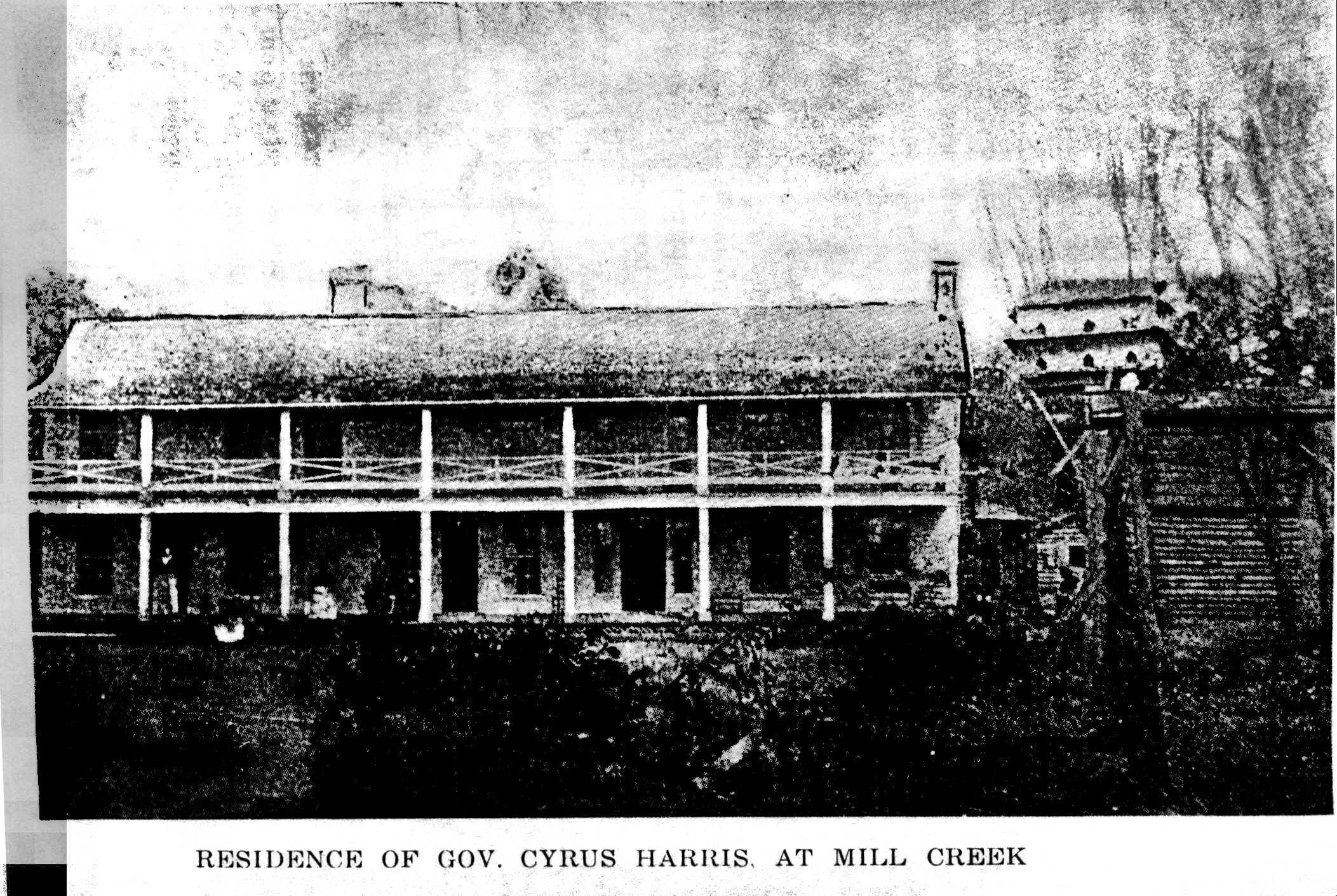
beginning his interest in politics. In 1855, he moved to Old Mill Creek and
lived there until his death in 1888.
Upon the ratification of the new Chickasaw
Constitution, in August of 1856, Harris was chosen as the first Governor. He was
re-elected in 1860 but defeated in the 1862 election by Dougherty Colbert. Amid
the Civil War now, the Chickasaw were angry that the U.S. Government had
abandoned the military post of Ft. Washita and Ft. Arbuckle, leaving the
Chickasaw and Choctaw at the mercy of the wild Tribes of the southwest such as
the Comanche and Kiowa. This prompted the Chickasaw to take the Confederacy's
side in the War. As the troops marched in review of the Governor, it is said
that Harris said "This is the first time in the history of the Chickasaw that we
have made war against the English speaking people". It was true, the Chickasaw
never went to war against the United States until they were abandoned by that
government.
In 1866,
Cyrus Harris was re-elected for a third term and for a fourth term in 1868 and a
fifth in 1872. He was again elected in 1876, but withdrew after the threat of
great bloodshed if his opponent was not seated as Governor. Harris was an
advocate of education and appropriated much money and signed much legislation to
establish boarding schools in the Nation. The Treaty of 1866 required the Five
Civilized Tribes to free their slaves. The Chickasaw and Choctaw also never
received the promised payment for the land given to the slaves or the payment of
the western one third of their land called the Leased Lands where the Comanche,
Kiowa and other plains Indians were relocated.
Cyrus Harris saw the coming of the allotments of
Indian Land and cautioned the Chickasaw Legislature thirty years in advance to
prepare for it. He saw the white settlers come into Mississippi do the same
thing fifty years earlier. He could see the end of the Chickasaw Nation and the
lands in common as he had seen them in Mississippi. In 1876, the white
intermarried residents of the Nation were admitted as Chickasaw citizens. Whites
married Chickasaw women and then divorced them after citizenship was granted.
Harris fought to fine the whites or ban divorce in the Nation.
Cyrus Harris had an innate ability to read his
constituents and keep his finger on the public pulse. He was a Progressive and
was a friend to the white man, the mixed bloods and the full bloods. He was a
farmer, a miller, cattleman, politician and grand representative of his people.
He was married to Kizzia Kemp, Tenesey and Hettie Frazier. Cyrus Harris was
truly a man of integrity, patriotism, generosity and self sacrifice. We could
sure use a few men like this today in our Capitols.
Dennis Muncrief - October, 2001
For more information, consult: Chronicles
of Oklahoma, Vol XV, No. 4; December 1937, pp. 370-387.